Algarve-Tourist.com
The best independent guide to the Algarve
Algarve-Tourist.com
The best independent guide to the Algarve
Vilamoura beaches: a complete guide for 2026
Vilamoura sit on one of the longest unbroken stretches of sandy coastline in the Algarve. Over 15km of golden sand, only broken by the marina entrance and Quarteira's fishing harbour, this is a coastline built for long beach days.
If you're in the early stages of planning and wondering whether the beaches are any good, they're some of the finest in the Algarve; soft golden sands, clean (if chilly) sea water, and so much space you'll find deserted sections even in the height of summer. If you want sand for your holiday, Vilamoura delivers.
This shoreline is vast. I've walked the entire length, west to where the red sandstone cliffs start to rise at Praia da Falésia, and east beyond Quarteira to the tranquil lagoon behind Praia do Almargem.
I've been exploring the Algarve with my Portuguese wife for over 25 years, visiting with friends, with my brother's young family, and with my older parents. This guide covers every beach in the Vilamoura area, with honest advice on which ones are worth your time.
Related articles: Vilamoura introduction - Day trips from Vilamoura
The beaches of Vilamoura
Praia de Vilamoura

The main beach of Vilamoura, sheltered by the marina's sea groyne, which keeps the water calm and safe for children. Soft golden sand, clean water, sun loungers for hire and the Purobeach club if you want something more polished. It's the closest beach to most of the hotels, so expect crowds in summer, but the setting and facilities are hard to fault.
Praia da Rocha Baixinha Nascente

Just the other side of the marina from Vilamoura's main beach, but with a noticeably calmer, less commercial feel. The sand is just as good, the water just as clean, and the beach stretches west for long enough that you can always find space. It's an easy walk from town, which makes it the natural second-day beach for most visitors, and personally, it's the one I prefer.
Praia da Falésia
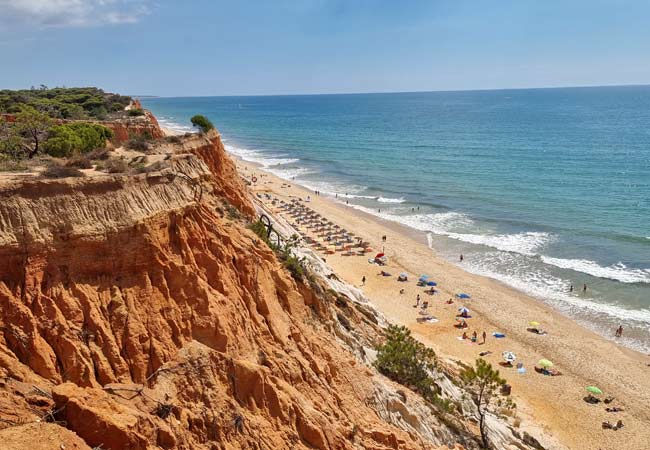
Five kilometres of wide sandy beach backed by towering red and ochre sandstone cliffs, widely regarded as one of the finest beaches in the Algarve. Walk west from Vilamoura and you'll watch the landscape transform as the dunes give way to these dramatic cliffs. Even in peak summer, walk far enough and you'll have the beach almost to yourself.
Praia de Quarteira

A long, generous stretch of sand running the full length of Quarteira's seafront, popular with Portuguese holidaymakers rather than international tourists. A pleasant promenade follows the shoreline, lined with some of the best-value seafood restaurants in the area. It has the same quality of sand and water as Vilamoura, just with more local character.
Praia do Almargem (Cavalo Preto)

The wild one. East of Quarteira, reached along a dusty unpaved track, Almargem feels like a different Algarve entirely. Low ochre cliffs, soft dunes, a pine forest behind and a seasonal lagoon at the river mouth where children wade after small fish. No high-rises, no beach clubs, just sand and space. If you want the authentic, undeveloped coastline the Algarve was once famous for, this is it.
Map of beaches of the Vilamoura region
The interactive map below shows the location of all beaches in the Vilamoura region. (Note: zoom in or out to see all points)
Legened: 1) Praia de Vilamoura 2) Praia da Rocha Baixinha Nascente 3) Praia da Falésia 4) Praia de Quarteira 5) Praia do Almargem
Why Vilamoura is a great beach holiday destination
If you're planning a beach holiday and weighing up European destinations, the beaches of Vilamoura are some of the finest you'll find. The sand is soft and golden, the water is clean, and the coastline is so long that even in peak August you can find a quiet stretch if you're willing to walk.
What gives Vilamoura the edge over many other resorts is the variety. You have a sheltered, family-friendly beach right next to the marina, and a calmer, less crowded alternative just the other side of it. A little further afield, a 20 minute walk or short Uber ride brings you to Praia da Falésia, a dramatic cliff-backed beach that ranks among the best in Portugal.
The beaches are well maintained, lifeguard-supervised through the summer, and flat enough to be accessible for visitors with limited mobility. These are safe, family-friendly beaches, and I've personally spent many days here with my young niece and nephew.
The only honest caveat is the sea temperature. This is the Atlantic, not the Mediterranean, and the water rarely gets above 20°C even in summer. You get used to it after the first shock, and I can assure you it becomes bearable once you've been in for a few minutes.

During the peak season all of the beaches are watched over by lifeguards and are safe for children and families.
The Praia de Vilamoura
Praia de Vilamoura is the main beach of the resort, stretching between the mouth of the marina and the fishing port of Quarteira. For most visitors staying in the hotel complexes, this will be the first beach you walk to, and for many it becomes the default for the entire holiday. It's easy to see why. The sand is soft and golden, the water is clean, and the facilities are excellent.
What makes this beach particularly good for families is the sea groyne that extends from the marina harbour mouth. It partially shelters the beach from the full force of the Atlantic, so the water here is noticeably calmer than on the more exposed beaches to the west. Children can paddle and splash safely, though you should always swim in the lifeguard-supervised areas and follow their advice on conditions.
The beach is well set up for a full day. Sun loungers and parasols can be hired, and there are beach bars and restaurants close by so you never need to trek far for food or drinks. If you want something a step up, the Purobeach club sits right on the sand and offers daybeds and a more polished experience. It also hosts regular parties through the summer evenings if you want to carry the beach day into the night.
The main downside is the crowds. Because this is the closest beach to the hotels and the marina, it gets very busy in July and August. If you arrive mid-morning in peak season, expect the prime spots near the water to already be taken. Getting here early makes a real difference, or you can simply walk west past the marina to Praia da Rocha Baixinha Nascente where there is more space.
Parking near Praia de Vilamoura is very limited, so it's best to walk from your hotel or take an Uber. If you're staying in the marina area, the beach is only a few minutes on foot.
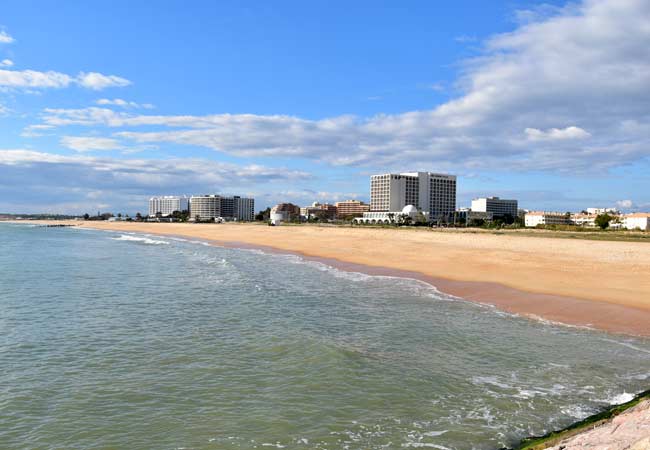
The Praia de Vilamoura on a quiet day in April, just expect it to be much more crowded when you visit!
Praia da Rocha Baixinha Nascente
Just the other side of the marina from the main beach, Praia da Rocha Baixinha Nascente offers the same soft golden sand and clean water but with a noticeably quieter, less touristy atmosphere. This is my preferred beach in Vilamoura. It feels more relaxed, there's more space, and the beach stretches west for kilometres, eventually transitioning into Praia da Falésia as the red sandstone cliffs begin to rise.
Because there is no sheltering sea groyne on this side, the beach is more exposed to the Atlantic swells. The waves here can be good for surfing and bodyboarding, and surf equipment can be hired from CIMAV Surfschool. Families with young children should stick to the lifeguard-supervised section closest to the marina, where the conditions are calmer.
There are four beachfront restaurants along this stretch: NoSoloÁgua (which doubles as a nightclub), Gomes na Praia, AL.MAR (part of the Hilton hotel) and Thai Beach Club. Unlike the main beach, there is a large paid car park directly behind the dunes, making this the easier option if you're driving.
A network of raised wooden boardwalks crosses the dunes between the car park and the sand. These protect the fragile dune vegetation, including sea holly and sea daffodils, so please stick to the walkways rather than cutting through.
The name sounds like a mouthful, but it breaks down simply. "Rocha Baixinha" means "the low rock," the point where Falésia's high cliffs taper down to sand dunes. "Nascente" means east. So it's just the eastern end of the low cliffs. Locals don't bother with any of that though. Ask a taxi driver for "Rocha Baixinha Nascente" and you'll likely get a blank look, but say "Praia dos Tomates" and they'll know exactly where you mean. Before Vilamoura became a luxury resort, the land behind the dunes was covered in tomato plantations, and the old name stuck.
If you want a break from the beach, the Parque Ambiental de Vilamoura sits just inland from the dunes. This 200-hectare nature reserve covers wetlands, reed beds and traditional orchards of carob, almond and fig trees. A 5km circular trail winds through the park, and there are two bird hides tucked into the landscape for spotting species like the Purple Swamphen, Purple Heron and Marsh Harrier. It's a surprisingly peaceful escape, just minutes from the sand.
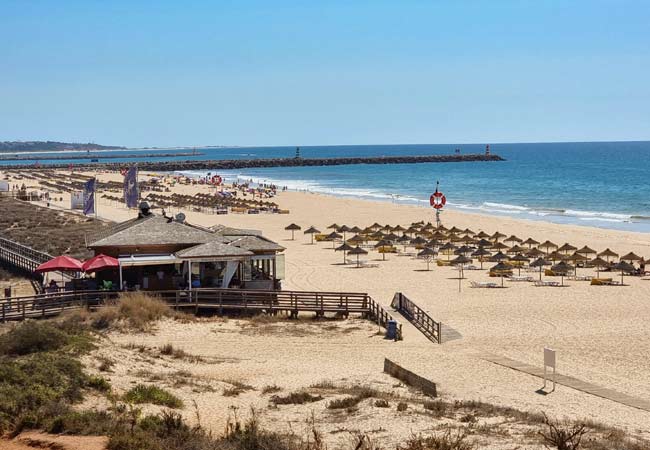
The walk around the marina to Praia da Rocha Baixinha Nascente is worth the effort, and this is where I head for my beach day when in Vilamoura.

Praia de Quarteira
Praia de Quarteira runs along the full length of the town's seafront, east of the fishing harbour. If Vilamoura's beaches have a polished, resort feel to them, Quarteira is the opposite. This is a working Portuguese town, and the beach reflects that. It's unpretentious, popular with Portuguese holidaymakers, and backed by local restaurants where you'll eat better for less than anywhere near the marina.
The beach itself is just as good as Vilamoura's. The same soft golden sand, the same clean water. A series of stone breakwaters divide the long stretch into sections and keep the water calm, making it another strong option for families with young children. The sand is well maintained and lifeguard-supervised through the summer.
Running the full length of the beach is the Avenida Infante de Sagres, known locally as the Marginal. This palm-lined promenade is the social heart of Quarteira, busy with families walking, older locals chatting on benches, and people drifting between the beach and the seafood restaurants that line the street. It's a lovely walk in the evening once the heat of the day fades.
At the western end of the promenade, close to the fishing harbour, is the Mercado do Peixe, Quarteira's fish market. Every morning except Sunday, the daily catch is laid out and sold. Next door is a fruit and vegetable market with locally grown Algarve produce. If you're staying in Vilamoura near the Tivoli hotel, Quarteira is a pleasant 15 to 20 minute walk along the harbourfront, and the market alone makes the stroll worthwhile.
Quarteira won't appeal to everyone. There are no beach clubs, no daybeds, no cocktail menus on the sand. But if you prefer a more traditional, local atmosphere and some of the best value seafood in the region, it's well worth a visit.
Related articles: Quarteira introduction

Quarteira has a much more Portuguese feel about it than Vilamoura

An art piece celebrating the fishing heritage of Quarteira
The Praia da Falésia
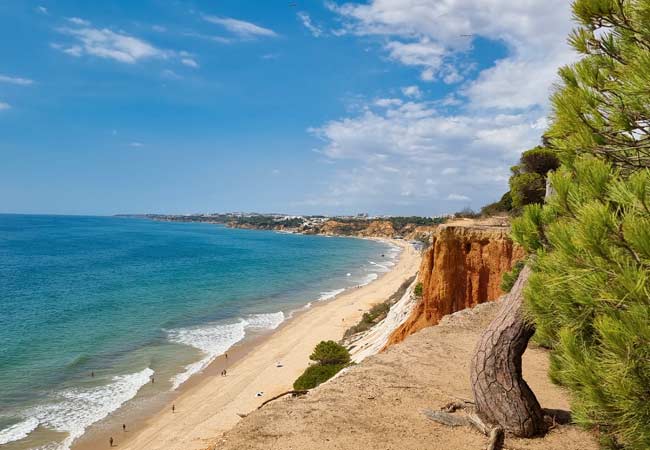
Praia da Falésia is widely regarded as one of the finest beaches in the Algarve, and it's not hard to see why. The name is refreshingly straightforward: "falésia" simply means cliff. This is the cliff beach, and it begins where the red sandstone cliffs start to rise, roughly a kilometre west of Vilamoura. From here the cliffs run west to the small town of Olhos de Água, with a wide stretch of golden sand beneath them the entire way.
With the cliffs standing at more than 40 metres high, they are the defining feature of the region. The vivid reds and oranges come from iron-rich sand and clay that has slowly oxidised over millions of years, essentially rusting as it meets the air and rain. Between the red layers sit bands of white quartz sand and kaolin clay, creating a striking striped effect that shifts in colour throughout the day as the light changes.
The sheer size of Falésia is its greatest practical advantage. Even in the busiest weeks of summer, the western sections remain quiet simply because most visitors don't walk that far. If you want space and seclusion without leaving the Vilamoura area, head west along the sand and keep going.
The beach is more exposed to the Atlantic than Vilamoura's main beach or Quarteira, so the waves here are bigger. This makes it a decent spot for beginner to intermediate surfing and bodyboarding, but families with young children should take more care and always swim near the lifeguards.
One of the best ways to experience Falésia is the cliff walk. A rough trail runs along the top of the cliffs, offering views down over the beach and out across the Atlantic. I've done this walk and it's one of the most scenic coastal paths in the Algarve. You can walk the beach to Olhos de Água and return along the clifftop trail, a round trip of about two hours. Just be aware that the sandstone is prone to erosion and can be unstable after rain.
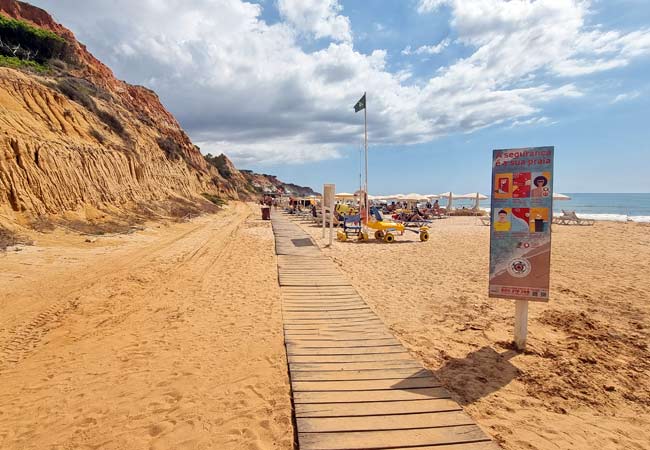
The red sandstone cliffs of Praia da Falésia tower above the beach
Me walking the clifftops towards Olhos de Água
Praia do Almargem (Cavalo Preto)
East of Quarteira, Praia do Almargem is the wild end of this coastline. There are no high-rises, no beach bars, no sun lounger concessions. Just low ochre cliffs, soft dunes, a pine forest behind the sand and a feeling of being somewhere the Algarve's tourism industry hasn't quite reached.
The beach is quieter than its neighbours even in peak summer, partly because the final stretch of access road is an unpaved, dusty track that puts off casual visitors. That remoteness is exactly the appeal.
At the mouth of the Almargem River, a small lagoon forms behind a natural sandbar. The calm, shallow water here is a favourite with children for wading and catching small fish and shrimp. In winter, heavy rain or high swells can break through the sandbar and flush the lagoon into the Atlantic, but through the summer months it stays calm and enclosed.
Locals know this beach as Cavalo Preto, meaning black horse. The name comes from a formation of dark, jagged rocks near the lagoon's mouth that, according to local lore, resembled the silhouette of a horse when seen from the sea. Fishermen and sailors once used features like this to navigate the coast, and the name has outlasted the need for it.
Our most popular articles for Vilamoura and the Algarve


Expert Insight: These guides are curated by Philip Giddings, a travel writer with over 25 years of local experience in Portugal. Since 2008, Phil has focused on providing verified, on-the-ground advice for the Algarve region, supported by deep cultural ties through his Portuguese family. Read the full story here.
 -
-


