Algarve-Tourist.com
The best independent guide to the Algarve
Algarve-Tourist.com
The best independent guide to the Algarve
The Algarve for a family holiday; should you go to the Algarve in 2026?
If you are looking for a family holiday with guaranteed sunshine, sandy beaches, and enough to keep children of every age occupied, the Algarve has been quietly delivering exactly that for decades. The fact that families keep coming back, year after year, tells you everything you need to know.
Most people come to the Algarve for the beaches, and with good reason. The coastline stretches for 220km and ranges from sheltered rocky coves ideal for younger children to vast sweeping sands perfect for a proper run-around. But the Algarve is more than its beaches. Traditional fishing villages, market towns, waterparks, and boat tours fill the gaps between beach days, and the whole region is compact enough that you are never far from whatever you need.
Picking the right base is where most families tie themselves in knots, and it is easy to see why. Every resort looks sun-drenched and perfect in the photos. The truth is that what suits your family depends on the ages of your children, what you want from your days, and how close you want to be to the centre of the action.
I first visited the Algarve in 2001, and between living in Portugal and marrying into a Portuguese family, I have never really stopped going back. Over the years we have explored it as residents, on family trips with young nieces and nephews, and on holidays with friends whose teenagers needed far more than a bucket and spade. From navigating the Algarve with a baby in tow and a toddler underfoot, to keeping a restless fourteen-year-old entertained, we have learned what works and what does not.
That mix of local knowledge and real family experience is what this guide is built on, covering everything you need to plan an enjoyable family holiday in the Algarve.
Related articles: Top 10 of the Algarve - The Algarve’s best beaches

Why the Algarve Works So Well for Families
The Algarve offers something increasingly rare: a coastline that genuinely lives up to the brochure. The beaches are broad and sandy, backed by ochre cliffs that glow in the afternoon light. The sun shines for ten to twelve hours a day through summer, yet Atlantic breezes keep temperatures comfortable rather than punishing. Children can spend full days outdoors without the exhausting heat that defines holidays in Turkey, Egypt, or southern Greece.
Portugal is a country that genuinely welcomes children. Restaurants accommodate families without fuss, waiters bring colouring pages unprompted, and hotel staff remember names. This warmth is cultural, not commercial, and it makes a tangible difference to how a holiday feels.
Practicalities fall into place easily here. English is spoken throughout the tourism industry. The infrastructure is modern and well-maintained. Safety is simply not a concern; the Algarve has one of the lowest crime rates in western Europe. And unlike comparable destinations in Spain or France, prices remain genuinely reasonable. A beachside lunch for four rarely exceeds forty euros. The value, in every sense, is hard to argue with.

The daytime maximum temperature (measured in the shade) and night-time minimum

The average hours of sunshine per day and amount of rain
Where to stay in the Algarve for a family holiday?
The Algarve stretches across more than 25 towns, so choosing the right base makes a real difference to how your holiday feels.
Most families settle in the central Algarve, the stretch running from Lagos in the west to Vilamoura in the east. This is where the large family hotels cluster, where the waterparks are, and where restaurants and excursion operators are on every corner. If you have booked a package holiday, this is almost certainly where you are headed.
The eastern Algarve, beyond Faro, offers a calmer and more authentically Portuguese experience. Towns are quieter, beaches are emptier, and the pace slows considerably. The trade-off is distance from the major attractions, so it suits families who are happy to keep things simple.
The far west beyond Lagos is wilder and more dramatic, with Atlantic-facing beaches that are genuinely stunning but better suited to families with older children, particularly those who surf or enjoy the outdoors.
For families with teenagers, the larger resort towns of Albufeira, Lagos, Praia da Rocha, and Vilamoura offer the widest choice of restaurants, watersports, boat trips, and evening entertainment. We took friends with teenagers to Albufeira last June and it delivered on every front: a boat trip to Benagil Cave, a day at Slide and Splash waterpark, and kayaking from São Rafael beach. Enough to pull them away from their phones, at least most of the time.
If you have younger children, the smaller towns are worth considering. Places like Carvoeiro, Alvor, and Praia da Luz are quieter, more manageable, and a much more relaxed experience for families with children who are not yet teenagers. When my sister visited with her one and four year old, Praia da Luz was exactly what they needed. Calm, easy, and completely at their pace.
The interactive map below shows the best family bases across the region. The larger resort towns are marked in yellow, the smaller towns in green, and theme parks in blue.
The large resorts: 1) Lagos 2) Praia da Rocha 3) Albufeira 4) Vilamoura
Medium sized beach towns: 5) Praia da Luz 6) Alvor 7) Carvoeiro 8) Armação de Pêra 9) Olhos de Água 10) Quarteira 11) Tavira
Water parks and theme parks: 12) Slide & Splash 13) Zoomarine 14) Aquashow Park 15) Aqualand
The Main Resort Towns of the Algarve
Albufeira is the largest and liveliest resort town in the Algarve, split into two distinct personalities. The Old Town retains its whitewashed houses and cobblestone lanes tumbling down to a wide sandy beach, while the New Town (known locally as "The Strip") pulses with neon-lit bars and late-night energy.
For families with older children or teenagers, this combination proves ideal: historic charm by day, entertainment by night. The beaches here are expansive and accessible directly from the town centre, removing any need for a car to reach the sand - Albufeira guide
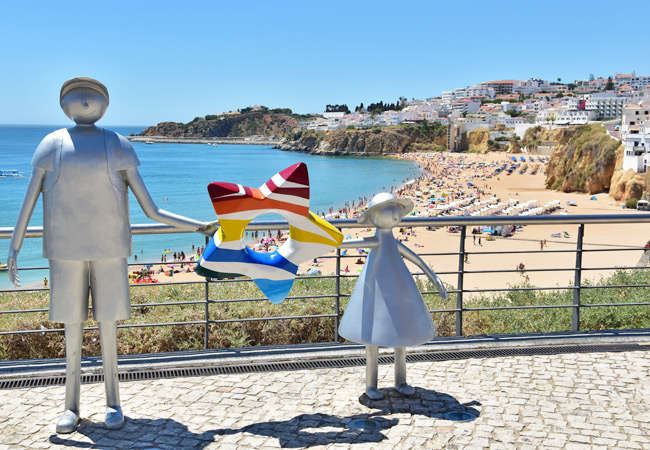
The beautiful sandy beach of Albufeira
Lagos blends Portuguese maritime history with some of the region's most dramatic coastal scenery. The town sits within 16th-century walls, its pedestrianised centre alive with street performers and artisan shops. Beyond the old quarter lies Ponta da Piedade, a series of golden sandstone cliffs riddled with sea caves and grottos accessible by kayak or small boat.
The coastline here is naturally sheltered, and beaches such as Praia da Dona Ana offer calmer waters than the surf-battered west coast, making them safer for swimming with children - Lagos guide

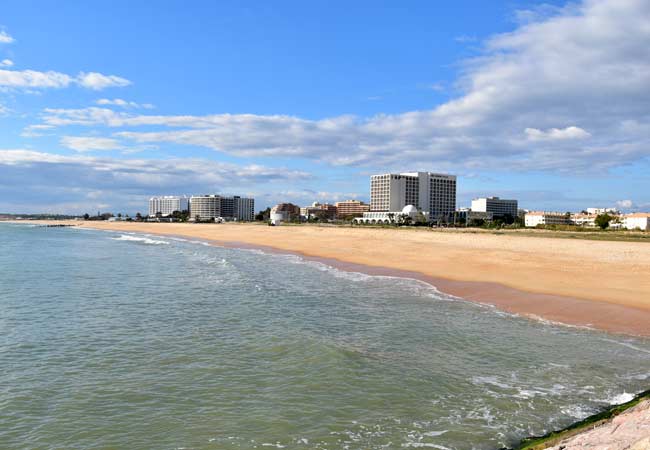
Vilamoura operates on an entirely different principle. This is a purpose-built resort, designed from scratch around a vast marina lined with superyachts and waterfront restaurants. Everything here is manicured: the lawns are trimmed, the pavements are wide, and the terrain is almost completely flat.
For parents pushing strollers or travelling with toddlers, this matters enormously. The steep hills that define other Algarve towns simply do not exist here. The atmosphere is quieter and more polished than Albufeira, with a focus on golf, cycling, and leisurely waterfront dining - Vilamoura guide.
Carvoeiro occupies a natural cleft in the cliffs, a former fishing village that has resisted the high-rise development seen elsewhere. Buildings remain low, streets remain narrow, and the pace remains slow. The town converges on a single small square that opens directly onto a beach framed by ochre-coloured rocks.
Almost every restaurant and shop sits along two main roads, so navigation is simple and children cannot wander far. Carvoeiro also serves as the nearest base for boat trips to the Benagil Cave, the most photographed sea cave in Portugal, located just a short journey along the coast - Carvoeiro guide

Alvor feels distinctly different from its cliff-backed neighbours. Here the coastline flattens into a wide lagoon and estuary system, attracting wading birds and creating miles of uninterrupted sand. The old village centre remains authentically Portuguese: narrow cobbled lanes, family-run restaurants grilling fish caught that morning, locals chatting on doorsteps. The beach stretches so far that even at the height of August, finding a quiet patch of sand for the family requires only a short walk - Alvor guide.

Praia da Luz centres on a broad sandy bay sheltered by a distinctive black volcanic headland. The town has long been popular with British families and carries a comfortable, familiar atmosphere. A promenade runs the full length of the beach, connecting cafés and ice cream shops without any need to cross traffic. The bay faces south and is protected from northern winds, producing some of the calmest paddling conditions on the coast. Water quality here is consistently excellent.

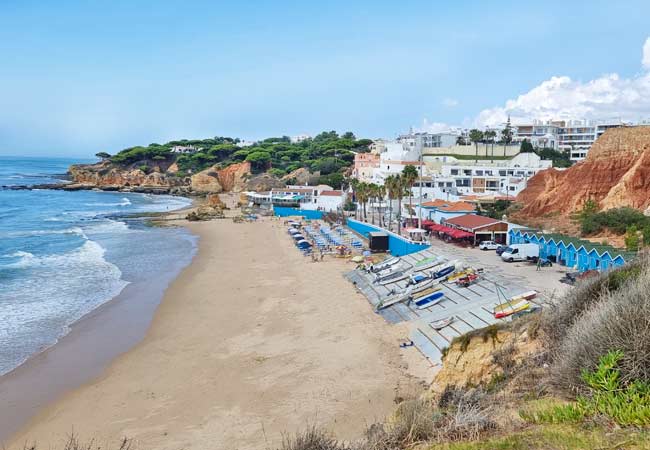
Olhos de Água, whose name translates as "Eyes of Water," grew from a fishing village into a low-key resort sitting between Vilamoura and Albufeira yet markedly quieter than either. The town remains compact enough that everything falls within walking distance, a practical advantage for families choosing not to rent a car - Olhos de Água guide
Towns to Avoid for a Family Holiday
Not every Algarve town suits families. Sagres, at the far southwestern tip, is a surfing hub but feels remote from the rest of the region, with limited dining options and a windswept atmosphere. Portimão is a working city of apartment blocks; its beach is actually at Praia da Rocha, which makes a far better base. Faro and Olhão both have historic appeal and excellent seafood, but their beaches lie on barrier islands accessible only by ferry, adding an awkward layer of logistics to each day at the sand.
For those drawn to Portugal but seeking somewhere more authentically local than the Algarve's resort towns, consider Cascais or Sesimbra near Lisbon, or the Silver Coast towns of Nazaré and São Martinho do Porto.
Popular activities for children in Algarve
Beyond the beaches, the Algarve offers enough attractions to fill every day of a fortnight without repetition. The following are the standout options for families.
• Zoomarine (Guia, near Albufeira) The region's flagship family attraction, combining a marine park with a full waterpark. Dolphin and sea lion presentations run throughout the day alongside a wave pool, the "Jurassic River" rapids, and a pirate acrobatics show. A full day is needed to cover everything, and the park suits all ages www.
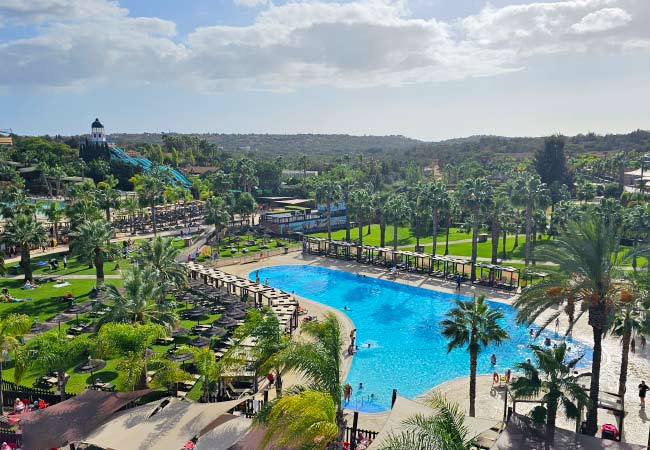
• Slide & Splash (Lagoa) Portugal's best dedicated waterpark. Teenagers head for the "Black Hole" and high-speed slides while younger children have "Tropical Paradise," a shallow interactive water playground. Large grassy areas make picnicking easy, and the park rarely feels overcrowded even in August. www.slidesplash

• Aquashow Park (Quarteira) A hybrid of waterpark and theme park, featuring one of Europe's largest water coasters. Height restrictions on the bigger rides mean this works best for children aged seven and above. aquashowpark
• Sand City (Lagoa) The world's largest sand sculpture exhibition. Artists carve 50,000 tonnes of sand into towering depictions of cartoon characters, historical figures, and famous landmarks. A good option for an overcast afternoon or a break from the beach.
• Krazy World (Algoz) A small interactive zoo designed for children aged three to ten. The emphasis is on hands-on contact: feeding goats and llamas in the petting farm, walking through a lemur enclosure, holding reptiles. Half a day is sufficient. www.krazyworld.
• Parque Aventura (locations in Albufeira, Lagos, and Vila Real de Santo António) High-ropes courses strung through pine forest, with routes graded by difficulty. A good choice for active families and older children, and a welcome escape from the midday sun. www.parqueaventura.net
• Dolphin Watching and Cave Tours (departing from Albufeira, Vilamoura, and Lagos) Boat trips to spot wild dolphins run daily throughout summer, often combined with a cruise past the sea caves and rock formations of the coastline. Tours range from large catamarans to fast RIB boats; the latter offer more thrill but a bumpier ride for younger children - two-hour dolphin tour for €35
• Santa Bernarda Pirate Ship (Portimão) A restored wooden sailing ship that runs coastal cruises to the Benagil Cave. The pirate theme and period rigging make this more memorable than a standard boat trip, particularly for children under ten. www.santa-bernarda.com
• Family Golf Park (Vilamoura) Two well-designed 18-hole mini-golf courses with a Roman theme, set in landscaped gardens. familygolfpark.pt
• Karting Almancil (Almancil) A go-kart circuit with a dedicated junior track for ages seven to twelve and an electric mini-track for children as young as three. One of the few activities where the whole family can race together. https://www.kartingalgarve.com/
• Silves Castle The Algarve's best-preserved medieval fortress, with open battlements and towers that children can explore freely. Far more engaging than a traditional museum, and the town of Silves below is worth a wander for its riverside cafés and traditional shops.
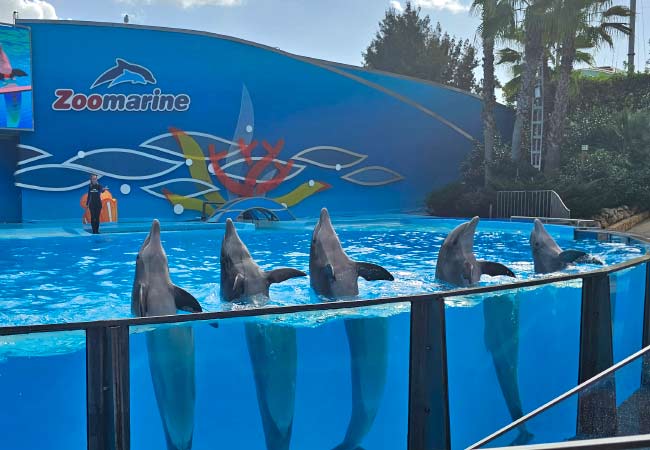
Zoomarine
Algarve Beaches for Families
The Algarve's coastline runs for over 200km, a succession of golden sand beaches broken by dramatic limestone cliffs and ochre-coloured rock formations. For families, the geography works in your favour: natural bays shelter much of the shore from strong currents, creating shallow areas where toddlers can paddle safely. One reality needs managing, however. This is the Atlantic, not the Mediterranean. Water temperatures rarely exceed 22°C even in peak summer, noticeably cooler than Greece or southern Spain.
For wide open spaces and easy access, the "mega beaches" of the central Algarve deliver. Praia da Rocha and Meia Praia are immense stretches of sand where finding space is never a problem, even in August. Praia da Falésia, between Vilamoura and Albufeira, runs for 6km beneath striking red cliffs, while Vilamoura's main beach offers flat access suited to pushchairs and young children.
For picturesque coves and calmer water, the region offers plenty of sheltered alternatives. Praia dos Pescadores sits in the heart of Albufeira, convenient and generally calm. Nearby Praia de São Rafael and Praia da Coelha provide the classic Algarve scenery of golden rocks and clear water. Praia do Barril, near Tavira, is worth the journey for its miniature train ride across the marshes to the sand. Praia da Luz and Praia de Carvoeiro are both excellent town beaches where the sand begins steps from the cafés and shops.
Throughout summer, the beaches come alive with pedalos, banana boats, and inflatable obstacle courses available for hire. Sunbed and parasol rental typically costs €15 to €20 per day for a pair of loungers and shade. Over a fortnight, this adds up. A cheaper option is to buy a parasol from a local supermarket on arrival and use the designated free zones that every beach provides for personal equipment.

Is the Algarve Expensive for a Family Holiday?
Portugal remains the most affordable country in western Europe, and the Algarve reflects this. Prices have risen in recent years, as they have everywhere, but a family holiday here still costs noticeably less than an equivalent trip to Spain, France, or Italy.
The savings show most clearly in food and drink. A filling lunch at a local restaurant rarely exceeds €12 per person. A three-course evening meal with wine typically runs €25 to €35 per adult, with children's portions cheaper still. Coffee, beer, and soft drinks all cost less than in competing destinations.
Many families assume half-board or all-inclusive packages offer the best value, but this is not always true in the Algarve. The region has hundreds of restaurants serving everything from traditional Portuguese grilled fish to international cuisines, almost all at reasonable prices. Self-catering or bed-and-breakfast arrangements often prove more economical while allowing greater flexibility and variety.
The largest expenses are flights and accommodation, both of which rise sharply during school holidays. July and August command premium prices, particularly in the larger resort towns. Booking early makes a significant difference: most hotels accept reservations up to twelve months ahead, and flights typically open six to nine months before departure. Families who can travel in June or September will find better availability and considerably lower rates.
Tips for a Family Holiday in the Algarve
Summer guarantees sunshine, but the heat from late June to August can be draining for young children. May, early June, and September offer a better balance: warm enough for the beach, cool enough for comfortable sleep, and noticeably quieter and cheaper than the peak weeks.
Several Algarve towns, including Albufeira, Lagos, and Carvoeiro, have old quarters with cobbled streets and steep hills. Small-wheeled pushchairs struggle on these surfaces. A baby carrier or a sturdier pushchair with larger wheels makes navigation far easier. The flatter resort areas and beachfront promenades present no such problems.
Pack sunscreen, after-sun, and any branded medications from home. These items cost two to three times more in Portugal than in most of northern Europe, and high-factor sun protection is essential. The Algarve sun is strong even in spring and autumn, when the breeze can mask its intensity.
Portuguese pharmacists are highly trained and can advise on minor ailments, often dispensing medication without a prescription. For anything more serious, the Algarve has modern medical facilities, but comprehensive travel insurance remains essential before any trip abroad.
Our most popular guides to the Algarve


Expert Insight: These guides are curated by Philip Giddings, a travel writer with over 25 years of local experience in Portugal. Since 2008, Phil has focused on providing verified, on-the-ground advice for the Algarve region, supported by deep cultural ties through his Portuguese family. Read the full story here.
 -
-


